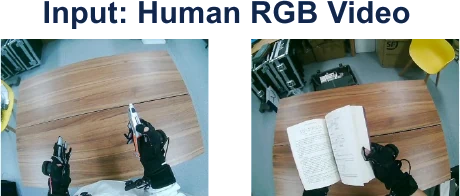
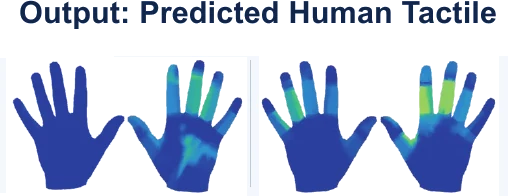
Predicting touch from egocentric human video for contact-rich robot manipulation
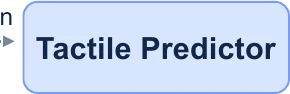
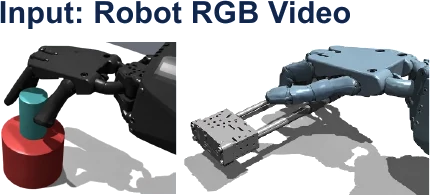
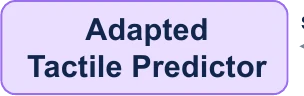
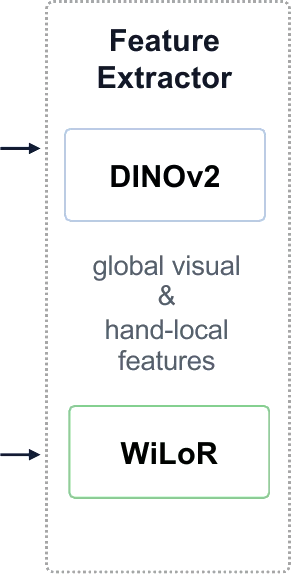
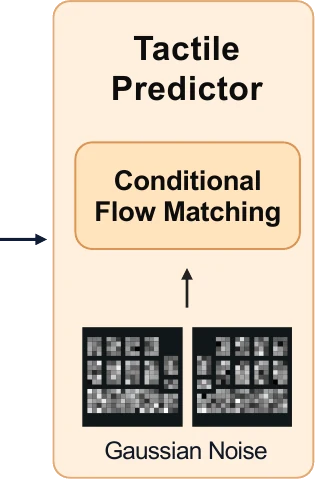
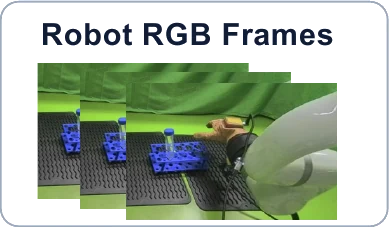
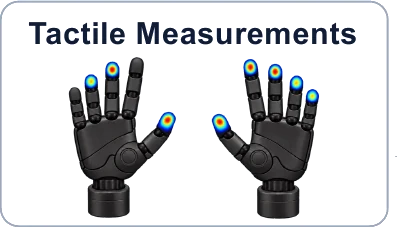
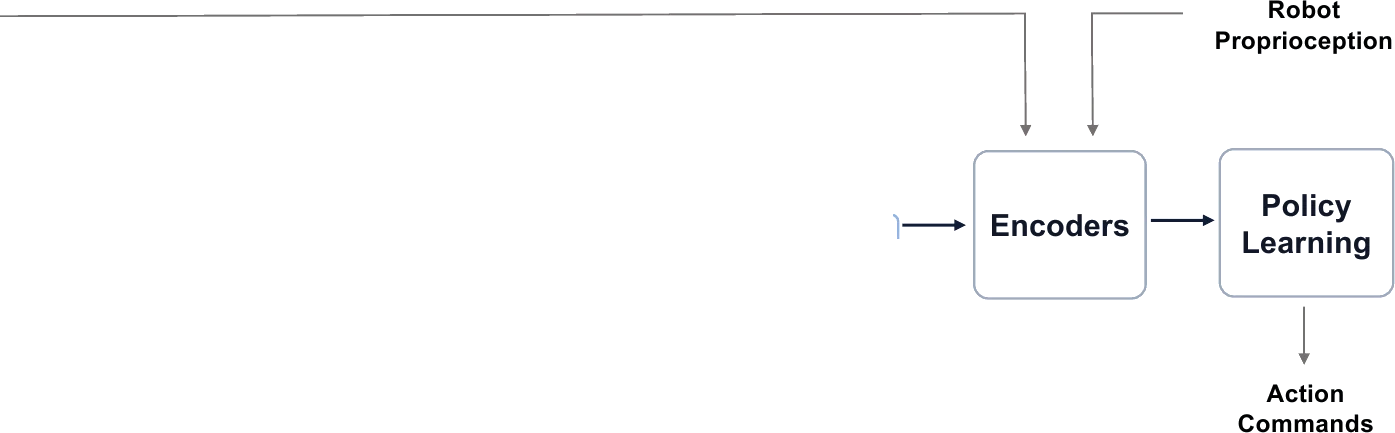
Ego2Contact learns a visual–tactile prior from human egocentric video paired with tactile-glove measurements, transfers it to robot hands through anatomical region correspondences, and uses the predicted touch as an observation for reinforcement learning in simulation and for vision-language-action post-training on a real dexterous hand.
A visual–tactile predictor is learned from paired human egocentric video and tactile measurements, fine-tuned to a dexterous robot hand through anatomical region correspondences, and used to supply touch for policy learning across four simulated and four real-world contact-rich tasks.
Touch is missing from the data that scales
01
Contact is ambiguous from vision alone.
Unscrewing a cap, inserting a tube into a rack or pouring between two hands depends on where contact occurs and how force evolves. A static image or hand pose does not determine the pressure underneath.
02
Robot tactile data is scarce.
Tactile skins and optical sensors are hard to integrate and tied to specific end-effectors, so tactile recordings are costly, rarely reused across platforms, and largely absent from cross-embodiment datasets.
03
Human video scales, but records no touch.
Egocentric human video is easy to collect. Recent glove datasets pair it with dense full-hand pressure, yet existing predictors stay in the human domain and do not drive a robot policy.
Can a tactile prior learned from human video supply explicit touch observations that robot policies can consume?
From a human touch prior to robot policies
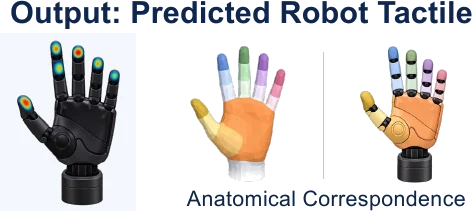
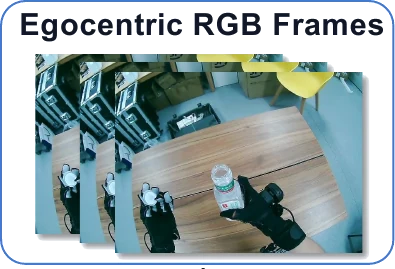
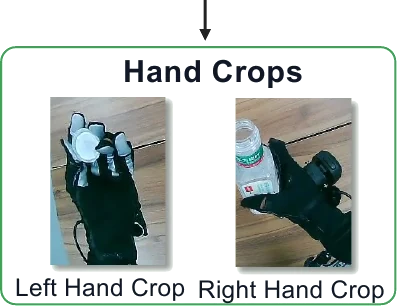
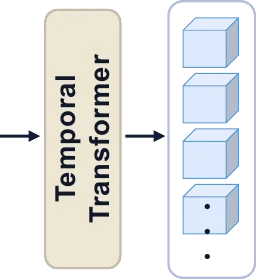
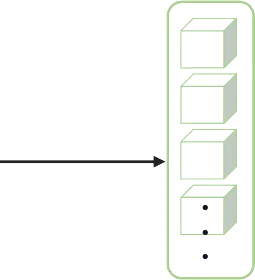
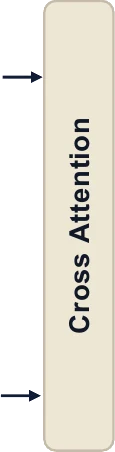
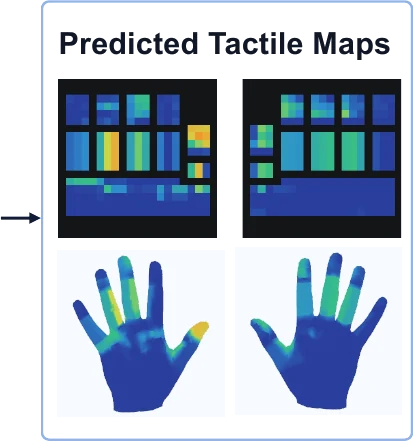
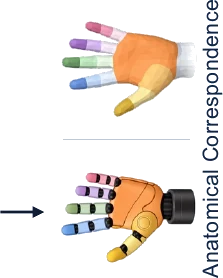
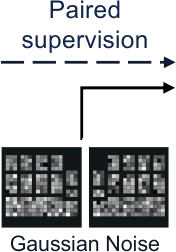
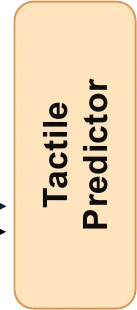
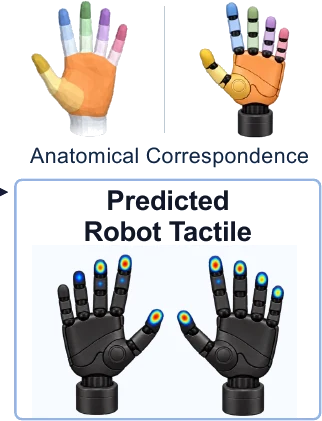
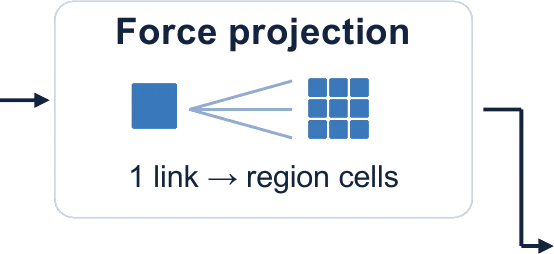
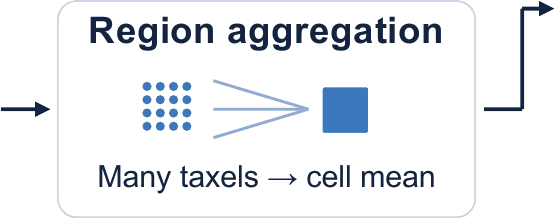
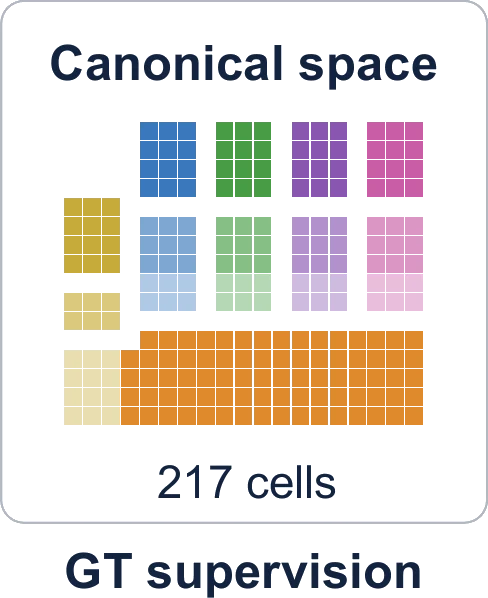
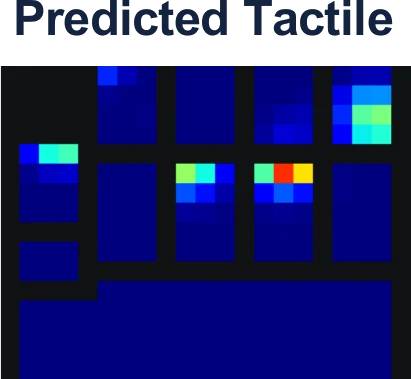
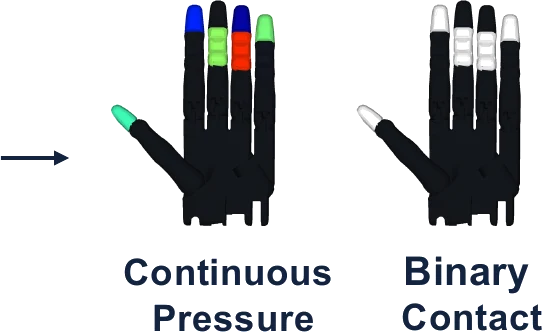
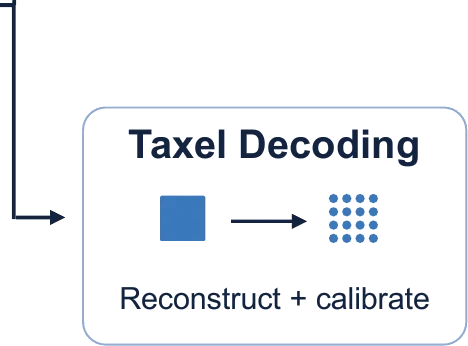
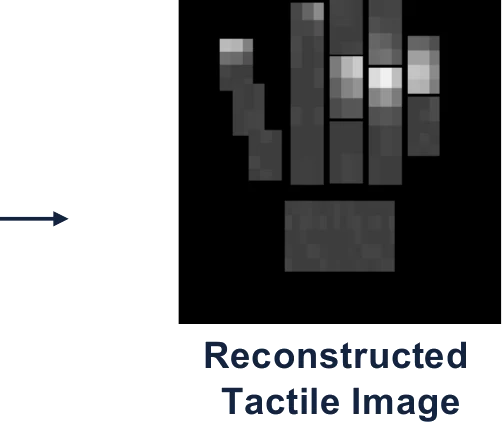
Ego2Contact formulates tactile estimation as conditional flow-matching generation over a canonical 21×21 hand grid, and uses anatomical region correspondences on that grid as the interface between human supervision, robot sensors, and policy inputs.
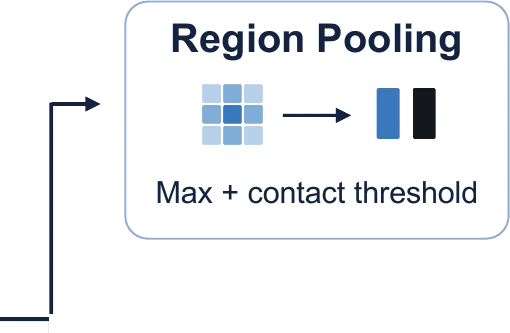
(b) Inverse mapping turns a predicted grid into policy observations.
Predicting touch from human video
On EgoTouch, Ego2Contact outperforms the TouchAnything baseline and a pose-conditioned variant on seen and unseen objects. Hand-local visual conditioning matters most when the object is new, and the advantage carries over to a second dataset, EgoTactile.
Human tactile prediction on EgoTouch (best per column in bold).
Method
Seen objects
Unseen objects
C.IoU ↑
V.IoU ↑
T.Acc ↑
MAE ↓
C.IoU ↑
V.IoU ↑
T.Acc ↑
MAE ↓
TouchAnything
0.5064
0.4260
0.8899
0.0485
0.4720
0.3457
0.8382
0.0641
Ego2Contact (pose)
0.5657
0.4899
0.9014
0.0385
0.4441
0.3183
0.8122
0.0596
Ego2Contact
0.5735
0.4961
0.9018
0.0383
0.4812
0.3417
0.8544
0.0590
Cross-dataset adaptation on EgoTactile (object-held-out split).
Each clip shows the model's RGB input (left) and the 21×21 pressure grids of both hands (right): ground truth on top, Ego2Contact prediction below. Pressure is normalised per sequence. Clips play while in view; click one to pause or resume it, or press ⤢ to enlarge it.
Adapting the predictor to robot hands
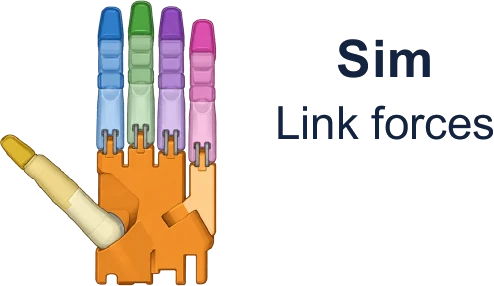
Ground-truth-tactile policies are rolled out in Isaac Gym to collect paired RGB and rigid-body contact forces. Fine-tuning on 8,741 clips from 2,258 episodes raises grid contact IoU on held-out robot episodes from 0.008 (human-trained checkpoint) to 0.476, with better contact placement than the adapted TouchAnything baseline.
Robot tactile prediction after adaptation to simulation (held-out episodes).
Method
C.IoU ↑
V.IoU ↑
MAE ↓
T.Acc ↑
Link C.IoU ↑
Link CoP ↓
TouchAnything
0.415
0.384
0.0025
0.992
0.520
0.300
Ego2Contact
0.476
0.440
0.0025
0.991
0.571
0.224
Predicted touch on the simulated hand, frame by frame
Browse held-out simulator episodes of the four tasks frame by frame. For each hand we show ground truth and prediction in the 21×21 canonical grid and on the hand surface, and pooled over the 17 link regions that the RL policy consumes. Values are normalised per task.
frame –
input frame (simulator camera)
pressure (norm.)
1.00.50
jump to frame
Grid: the right hand is drawn mirrored (thumb on the left); each grid column lines up with the finger drawn on the hand. Hand: canonical flat hand, each link coloured by its pooled value; links below 0.03 stay black. Episodes shown were not used for predictor fine-tuning gradients. ← / → keys step frames.
Simulation: predicted touch as a virtual tactile sensor for RL
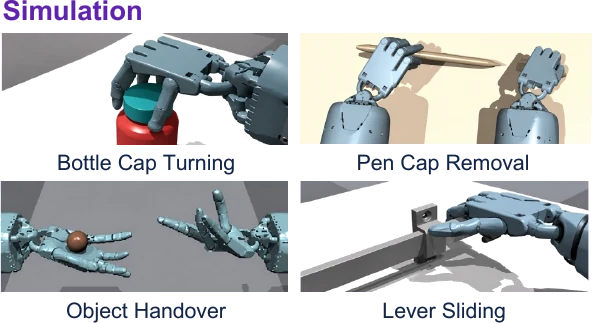
Four contact-rich dexterous tasks in Isaac Gym: Pen Cap Removal (built on Bi-DexHands) and Lever Sliding, Bottle Cap Turning and Bimanual Handover (adapted from VTDexManip). Every PPO policy receives the proprioceptive base observation (robot state and task-required state); the two tactile conditions append online predicted or ground-truth tactile in a matched 17-link representation (17 pressure values and 17 contact flags per hand).
Successful executions of the four simulated tasks (episodes from the ground-truth-tactile rollouts collected for predictor adaptation).
Policy success rate
PP + Pred-TacP + GT-Tac
Pen cap removalLever slidingBottle cap turningBimanual handover
Success rate (%), averaged over 4 seeds.
Task
P
P + Pred-Tac
P + GT-Tac
Pen cap removal
0.0
1.0
95.0
Lever sliding
84.0
88.8
98.2
Bottle cap turning
64.1
71.0
74.1
Bimanual handover
29.3
33.1
49.1
Predicted tactile improves over the proprioception-only baseline on three of four tasks and approaches ground-truth tactile on bottle-cap turning.
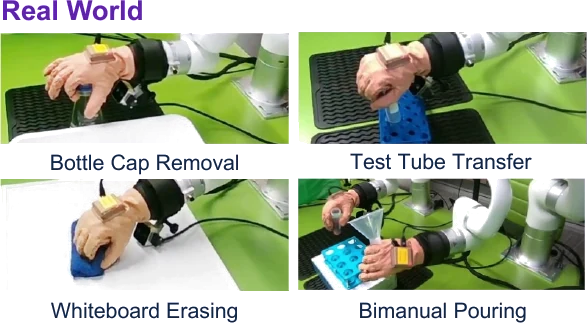
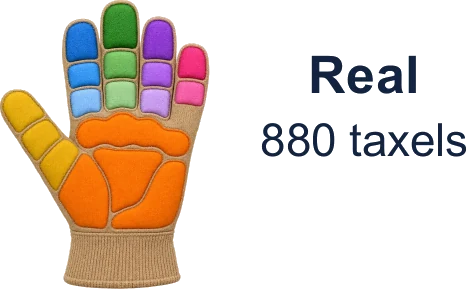
A single-arm platform with a dexterous hand wearing a 15-pad, 880-taxel glove, a head RGB-D camera and a wrist camera. Demonstrations are collected by VR teleoperation; the human-trained predictor is adapted on about 123k paired robot frames and then annotates demonstration videos with tactile images used to post-train a vision-language-action policy. We post-train three variants that differ only in the tactile image stack the policy sees during post-training: zero-valued tactile (the tactile input is all zeros, i.e. no touch information), predicted tactile (tactile images generated by the adapted Ego2Contact predictor from the demonstration videos; ours), and measured tactile (the glove readings recorded during the demonstrations). During rollouts every policy receives the glove's measured tactile.
Average success rate over the four tasks
27.5%zero-valued tactile
45.0%predicted tactile (ours)
55.0%measured tactile
Real-robot success counts over 10 trials per task.
Task
Zero
Pred
GT
Bottle cap removal
5/10
7/10
7/10
Test tube transfer
3/10
5/10
6/10
Whiteboard erasing
2/10
3/10
4/10
Bimanual pouring
1/10
3/10
5/10
Zero: zero-valued tactile · Pred: predicted tactile (ours) · GT: measured (glove) tactile, all referring to the tactile input used during policy post-training.
Rollouts of policies post-trained with predicted tactile
Head-camera view with the wrist camera(s) inset at the top. These are individual qualitative rollouts, not aggregate success-rate estimates.